United States Firms Slowly Adopting AI-Powered Risk Management Solutions
NEW YORK, March 4, 2026 – A new global survey of financial services regulatory compliance professionals reveals that 69% believe the accelerated use of AI is most likely to cause compliance issues in 2026, followed by increasing regulatory uncertainty (65%), global economic and geopolitical instability (54%) and digital assets and crypto markets (51%).
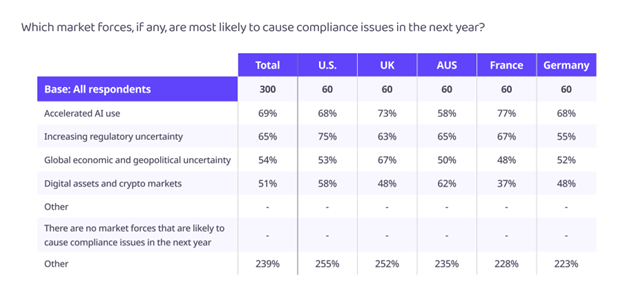
American respondents ranked increasing regulatory uncertainty the highest (75%) and AI second (68%). Their increased focus on the regulatory environment perhaps reflects shifts due to President Trump's second term, significant changes at the SEC and other regulatory agencies and a general 'resetting' in terms of regulatory approach.
The survey data is included in the third annual “Global Trends in Market Abuse and Trade Surveillance Report 2026,” published by eflow Global, a leading provider of regulatory compliance technology for financial services organizations. It provides a global snapshot of the emerging risks reshaping compliance teams’ priorities – and the growing expectations placed on both firms and regulators. The research was conducted in January 2026 with 300 senior regulatory compliance decision-makers in the United States, Europe and APAC.
AI-driven risk and readiness gaps
Despite the huge advances in the use of AI across all business operations in the last 24 months, its use in trade surveillance is lagging behind.
American respondents indicate just 17% of firms have fully deployed AI within their trade surveillance operations today (16% globally), despite widespread expectations that AI-enabled surveillance will become a core regulatory expectation in the coming years. A further 35% of U.S. firms (31% globally) are actively rolling out AI in specific areas, while 25% of U.S. firms (24% globally) plan deployment within the next 12 to 24 months.
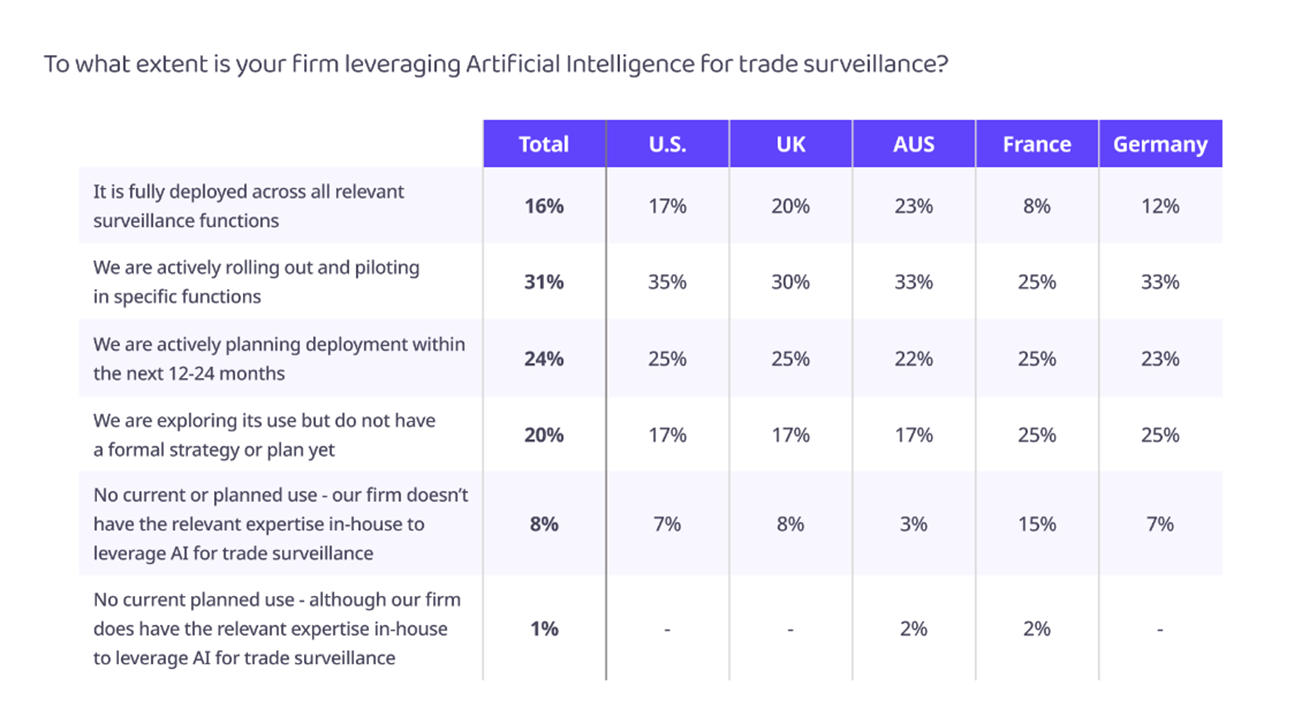
The data reveal that strategic readiness remains uneven. Nearly one quarter of U.S. firms (24%), and 29% of all firms, do not currently have a formal strategy for how AI will be used as part of their trade surveillance strategy, or do not plan to use AI at all.
Ben Parker, co-founder and CEO at eflow, commented: “AI is now reshaping both how markets operate and how misconduct can emerge. Our 2026 findings show that firms clearly recognize this shift, but many are still building the foundations needed to deploy AI responsibly and effectively within their trade surveillance operations. At the same time, regulatory uncertainty and ongoing market volatility continue to place compliance teams under sustained pressure. Stronger collaboration between firms and regulators will be essential to ensure innovation can progress without undermining market integrity.”
U.S. enforcement actions and fines in 2025
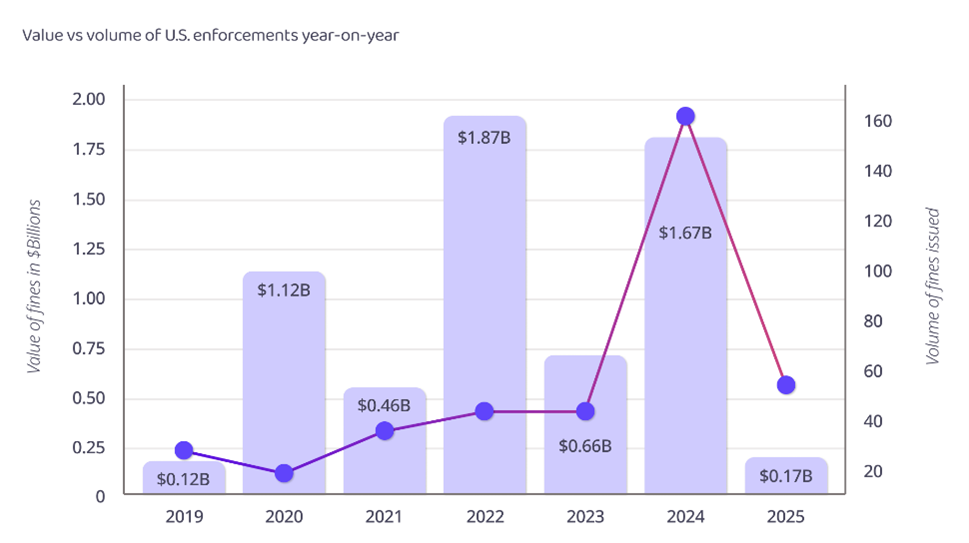 In 2025, U.S. enforcement actions fell to their lowest level since 2019, with the SEC issuing $125.9 million in fines and FINRA issuing $37.2 million. U.S. enforcement fines were significantly down from the prior year’s $1.67 billion in fines because of changes in key personnel at the main regulatory bodies and due to the 43-day federal government shutdown in the fourth quarter. Regulators issued smaller fines to a wider range of firms – pushing down into the mid-market and not only tier-one firms.
The Commodities Futures Trading Commission (CFTC) cleared backlogs of low-level cases through fast-tracked settlements while reserving investigative firepower for conduct that posed genuine client harm or market integrity risk. The result was smaller fines, quicker resolutions and tangible cooperation credit, paired with an explicit reallocation of resources toward more serious abuse. For example, in the third quarter, minor fines against banks for eComms surveillance failures and trade system and control errors were settled swiftly with firms receiving mitigation credit for self-reporting. U.S. regulators were clearly drawing lines between fixable weaknesses in systems and controls and persistent failures, poor judgment or behavior that undermines market integrity.
A shift in who was issuing eComms fines in 2025 reveals a change as to who is being scrutinized. In 2025, all eComms record-keeping enforcement originated in the U.S., with FINRA issuing 53.3% of enforcement actions by volume, followed by 31.1% by the SEC and 15.6% by the CFTC—a shift in the historical pattern where traditionally the SEC has accounted for approximately 60% of enforcement actions over the past five years, compared with 22.1% by the CFTC and 17.7% by FINRA. This reflects a change in enforcement moving down-market to small- and mid-sized broker-dealers that are under the auspices of FINRA versus the SEC or CFTC.
"Whether U.S. enforcement volumes remain elevated will depend on remediation outcomes," said Parker. "If recordkeeping improves, regulators may gain greater visibility into underlying misconduct and we may see the enforcement mix shift to other typologies. If it does not, further waves of recordkeeping enforcement remain likely. Regardless, we expect firms of all sizes to be the focus of regulatory enforcement in 2026."
Other Findings
- When asked about market abuse and their main regulatory challenges keeping them awake at night, U.S. respondents cited their top three concerns as keeping abreast of regulatory challenges (60% vs. 53% globally), integrating trade and eComms surveillance (58% vs. 40% globally) and accurately identifying insider trading and market manipulation (37% vs. 42% globally).
- With respect to digital asset and crypto market compliance challenges, there was a significant uptick compared to 2024. This year, 58% of U.S. respondents (51% globally) expressed concern up from 37% in the U.S. and 29% globally in 2024.
About eflow:
Founded in 2004 and with U.S. offices in New York, eflow provides financial firms with technology solutions to help them comply with their regulatory requirements in a more streamlined, efficient and robust way. It offers award-winning solutions for market abuse surveillance, best execution, transaction-cost analysis, transaction reporting and eComms surveillance.
The company currently services over 140 clients across five continents, providing both buy-side and sell-side firms with highly configurable digital tools that are designed to keep them compliant and competitive in this ever-changing regulatory landscape. eflow’s regulatory solutions are delivered through a PATH, a unique digital ecosystem that offers the speed, convenience and efficiency of off-the-shelf software, combined with a level of customization that is typically only associated with a bespoke platform.
Editor’s Note: Complete survey findings and high-resolution images of survey findings are available upon request. Interviews with eflow spokespersons can be scheduled by contacting eflow@feintuchpr.com.